IN
 USA
 PH
 ZA
 LATAM
 Global

Theme : AI, Scale & the Future of Enterprise Commute
30th July 2026 | Sheraton Grand, Bund Garden, Pune
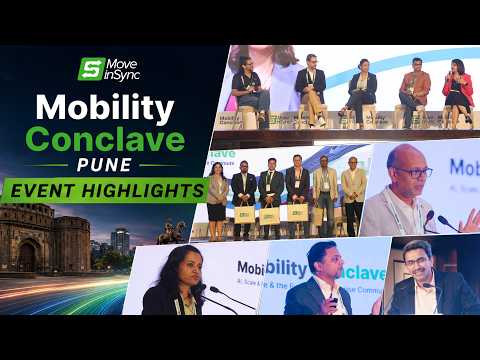
MoveInSync Mobility Conclave Pune brought together enterprise leaders to address one of the defining challenges facing modern enterprises: building mobility systems that can keep pace with rapidly changing workforce demand.
The discussions explored how AI is transforming enterprise mobility from reactive operations to intelligent, adaptive decision-making. Conversations spanned demand volatility driven by workforce expansion, multi-site campuses, hybrid work patterns, and staggered shifts, while highlighting how AI, data, and operational intelligence are helping organizations build resilient, scalable, and employee-centric mobility ecosystems.
How it Unfolded
Opening Address
Deepesh Agarwal
Deepesh opened with a stark framing: the average Indian now spends 8% of their life commuting to work, up from 7% five years ago. He positioned Pune as one of India’s fastest-growing GCC hubs, with MoveInSync alone running 100,000 daily rides in the city, even as the average one-way commute has stretched to 59 minutes, costing each employee 306 hours, or 38 working days, a year.
He showcased MoveInSync’s suite of AI agents built to make commutes smarter and safer, including MASAI, now live with 40,000 employees.
He closed with a personal appeal: with Pune and Pimpri-Chinchwad now home to roughly 78.5 lakh vehicles, he asked the room to leave the car at home one day a week, citing a potential 20-30% cut in commute time if adopted at scale, and pointed to MoveInSync’s carpooling option as a way to make the other days work too.
Deepesh Agarwal
CEO & Co-Founder, MoveInSync
Panel 1
The Enterprise Lever: How CXOs Are Shaping Mobility Beyond Their Own Gates

The panel, moderated by Sameer Shaikh (XPO), brought together facilities, procurement, and FM leaders from Kimberly Clark GCC, Eaton, Tata Technologies, and Citibank to discuss how Pune’s GCC boom is reshaping mobility beyond the office gate. Sandeep framed mobility as now central to the boardroom, citing that GCCs absorbed 70% of Pune’s commercial real estate in the first quarter of 2026 and that women account for the majority of night-time mobility usage on the platform.
Major Pramila shared Eaton’s transformation story: after standardising governance and policy and partnering with MoveInSync, the company cut its Pune fleet from 250 cabs to 98 while growing headcount, delivering roughly 20% cost efficiency and letting real estate be reallocated around the Tuesday-Wednesday-Thursday attendance peak. Ashish described mobility as “a state of mind” that sets the tone for an employee’s entire day, and pushed for companies within the same business park to pool demand and negotiate as a cluster rather than individually, while flagging the absence of a government carpooling policy as the biggest blocker.
Capt. Kaur traced transport’s evolution from a talent-attraction perk to a multi-stakeholder ESG issue, noting that Scope 3 emissions make up roughly 95% of facility teams’ reporting burden and that a Mumbai carpool-Friday pilot saw around 90 companies sign up but low uptake internally. The panel closed with a show of hands on who had carpooled to the event, and Sameer summed up the shift as one from cost conversations to strategic ones, with AI and technology partners like MoveInSync set to play a growing role.

Panel 2
When Demand Won't Sit Still: Running and Funding Mobility on the Ground

The panel, moderated by Amit Raual (Listenlights Pvt. Ltd.), brought together people, admin, and procurement leaders from CITCO, ZS Associates, and Dentsu to discuss what it actually takes to run and fund mobility programmes once they are up and running. Amit opened by reframing employee transport as no longer a perk but a driver of core organisational outcomes, tied directly to attrition and workplace wellness.
Khanderao shared a striking anecdote: a senior candidate’s final question in her interview was how her commute would be managed, having quit her last job over a mere 20-minute increase in travel time. Vijay offered a more optimistic lens on growth, arguing that a larger rider base brings a better economy of scale and lower per-head cost, while also flagging a generational wrinkle: some Gen Z employees now push back on getting the same cab benefit regardless of how close they live to the office, asking for a cash alternative instead.
The panel agreed hybrid work has made demand unpredictable, with some organisations now taking bookings just 30 minutes before pickup, leaving vendors unable to plan capacity, while AI is starting to help by predicting employee and driver behaviour instead of just tracking utilisation. On selecting partners, Vijay argued the choice should hinge on technology and managed-service capability rather than per-seat cost, while Vinod noted that a past experiment swapping transport for a cash allowance was reversed within months once reliability concerns resurfaced.
The panel closed by unanimously placing employee experience ahead of cost and punctuality, framing transport as a long-term strategic enabler rather than a cost line to be cut.

Engineering the Trust: How Risk & Governance Protects Every Commute
Sangeetha opened by tracing MoveInSync’s decision three years ago to set up an independent Risk & Governance function reporting directly to the board, separate from operations, sales, and customer success. She walked through the driver fatigue monitoring system built after a near-fatal accident, now a closed loop of four parameters (trip count, continuous driving duration, distance, rest hours) that automatically caps trip allocation, backed by in-cab cameras and post-trip feedback; over six months, this delivered a 16% drop in incidents and a 25% drop in drowsy-driver feedback despite a 12% rise in trips.
She described the Ombudsman programme, launched after payment-chain disputes led to driver disruptions, giving drivers a direct channel for payment and bribery complaints via monthly WhatsApp reminders and a monthly no-dues certificate, both in regional languages.
On training, she explained the shift from paper-based attendance to an app-based Driver Training Module, letting drivers train and get assessed at their own pace in their own language, with audit-ready records.
She closed with a look at the Central Command Centre, which monitors every trip, responds to alerts within 60 seconds against an industry benchmark of 180 seconds, and manages over 35,000 trips a month.
Sangeetha Pai
Director – Risk & Governance, MoveInSync
Transformation of Facility Management: Rise of Workplace Experience
Ujjwal framed facility management’s shift from a back-office function to a strategic seat at the table, noting that FM teams are now expected to shape hybrid policy (bordering HR), generate data-led insights (bordering IT), and manage space costs (bordering finance).
He cited global data showing average office space utilisation at just 53%, even as demand for AI-generated workplace insights has jumped from 15% to 78% of organisations in three years, and open roles in workplace experience management (WXM) have grown 300% globally.
He shared real client results: one organisation scaled occupancy from 90% to over 215% on the same real estate footprint, while a global consulting firm now manages 32,000 people across just 8,000 desks. He closed with a simple provocation for the room: an organisation’s growth is not equal to its real estate growth.
Ujjwal Trivedi
Vice President - Products & Growth, MoveInSync
The Build: What's New in Intelligent Mobility
Viswesh organised his session around three shifts: giving employees more ways to commute, automating compliance, and using AI to make both easier.
On multi-modal commute, he reframed metro and carpool programs as fully facilitated services, from office-vehicle first-mile shuttles to metro stations to in-app carpooling with verified colleagues and incentives, rather than simply opt-out schemes companies wash their hands of. On compliance, he showed how integration with the government’s mParivahan database now lets AI verify vehicle documents in minutes instead of a day-long manual process, and how Marshal Management now optimises deployment the way driver allocation already does, cutting the headcount needed for the same safety coverage.
He closed with live demos of two AI agents: MASAI, a chat assistant answering questions like drop times and OTPs, and Saarthi, a voice-based, accessibility-first version of the same for employees who cannot easily use an app. He summed it up as five capabilities across three pillars, all aimed at reducing the operational load on the facilities team while putting a smile on the employee’s face.
Visweswaran Gowrisankaran
Chief Customer Officer, MoveInSync
Agenda